India Cricket Jersey Numbers: Shirt Numbers and Stories
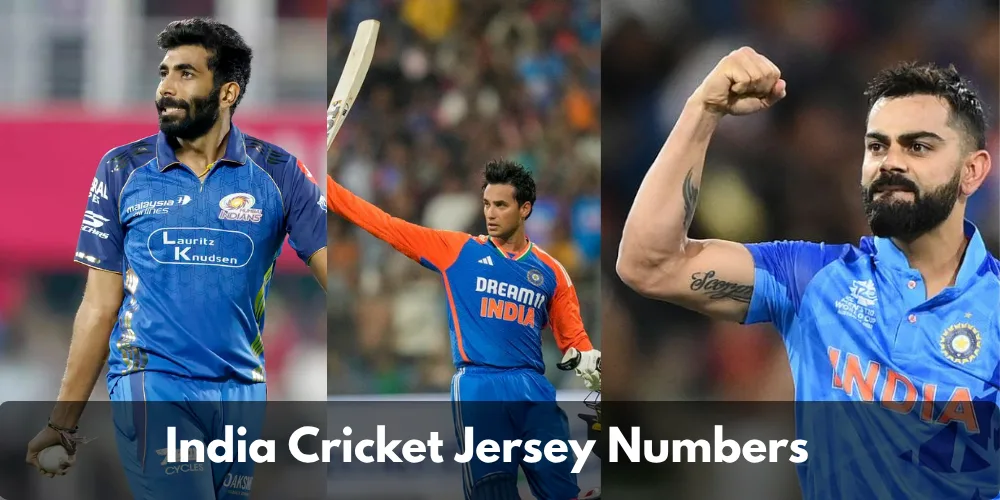
India cricket jersey numbers are memorable identifiers, but they are not a permanent squad register. A player’s number can become closely associated with one career, yet shirt allocations may differ across periods and formats, while some published lists contain repeated entries for the same player.
The clearest stories belong to numbers such as MS Dhoni’s 7, Sachin Tendulkar’s 10 and Virat Kohli’s 18, all of which have taken on meaning beyond the name printed above them.
How to read India’s jersey-number lists
A jersey number helps supporters identify a player quickly in limited-overs cricket, especially when several names and roles are changing within a squad. However, a number should not be treated as proof that a player is currently selected for India. International squads are announced series by series, whereas number directories often include players from different years and different stages of their careers.
That distinction matters because the available India number list includes multiple entries for some players. Ravindra Jadeja, for example, appears against 8, 22 and 46. Mohammed Siraj appears against 50, 58 and 73, while Prasidh Krishna appears against 24 and 43. Rather than assuming every number is simultaneously active, readers should view such lists as a record of shirt-number associations that may have changed over time.
The India men’s side has had separate leadership roles across formats. As of 11 October 2026, the team listing recorded Shubman Gill as Test and ODI captain, with Shreyas Iyer as T20I captain. This makes it especially useful to separate a player’s present role in a format from the number that may be most familiar to fans.
India players and shirt numbers commonly listed
The following table brings together the contemporary India players and recent internationals named in the available jersey-number directory. It is best used as a practical reference rather than a definitive current-squad announcement.
| Player | Shirt number listed | Listed role |
| KL Rahul | 1 | Wicketkeeper-batsman |
| Arshdeep Singh | 2 | Bowler |
| Yuzvendra Chahal | 3 | Bowler |
| T. Natarajan | 4 | Bowler |
| Washington Sundar | 5 | All-rounder |
| Ravindra Jadeja | 8 | All-rounder |
| Sanju Samson | 9 | Wicketkeeper-batsman |
| Mohammed Shami | 11 | Bowler |
| KS Bharat | 14 | Wicketkeeper-batsman |
| Rishabh Pant | 17 | Wicketkeeper-batsman |
| Virat Kohli | 18 | Batsman |
| Axar Patel | 20 | All-rounder |
| Kuldeep Yadav | 23 | Bowler |
| Prasidh Krishna | 24 or 43 | Bowler |
| Rahul Chahar | 28 | Bowler |
| Varun Chakaravarthy | 29 | Bowler |
| Ruturaj Gaikwad | 31 | Batsman |
| Ishan Kishan | 32 | Wicketkeeper-batsman |
| Hardik Pandya | 33 | All-rounder |
| Rinku Singh | 35 | Batsman |
| Devdutt Padikkal | 37 | Batsman |
| Shreyas Iyer | 41 | Batsman |
| Mukesh Kumar | 49 | Bowler |
| Mohammed Siraj | 50, 58 or 73 | Bowler |
| Shardul Thakur | 54 | All-rounder |
| Ravi Bishnoi | 56 | Bowler |
| Deepak Hooda | 57 | All-rounder |
| Suryakumar Yadav | 63 | Batsman |
| Avesh Khan | 65 | Bowler |
| Sai Sudharsan | 66 | Batsman |
| Shivam Dube | 70 | All-rounder |
| Tilak Varma | 72 | Batsman |
| Shubman Gill | 77 | Batsman |
| Rajat Patidar | 87 | Batsman |
| Deepak Chahar | 90 | Bowler |
| Jasprit Bumrah | 93 | Bowler |
Numbers such as 1, 8, 17, 18, 33, 45, 63, 77 and 93 are particularly easy for viewers to recognise because they have been repeatedly connected with high-profile India players. But a number on a shirt is only one part of reading a match. Team balance, venue, conditions and recent form generally tell a fuller story, which is why readers following a fixture often compare squad news with a Cricket Match Prediction before forming their own view.
The jersey numbers with the strongest stories
MS Dhoni and number 7
Number 7 is one of Indian cricket’s most recognisable shirt numbers because of MS Dhoni. The number reflected his birth date, 7 July, and he also admired footballer David Beckham, who wore the same number. Dhoni’s association with 7 became inseparable from a career that included India’s victories in the ICC T20 World Cup in 2007, the ICC Cricket World Cup in 2011 and the ICC Champions Trophy in 2013.
The BCCI retired Dhoni’s number 7 in 2023. That decision means the number is not simply remembered as an individual preference; it is an official tribute to a player whose captaincy shaped a major era for India. It also illustrates why fans attach importance to jersey numbers even though a shirt number does not affect what happens on the field.
Sachin Tendulkar and number 10
Sachin Tendulkar is synonymous with number 10. He initially wore 99 before moving to 10, reportedly on an astrologer’s advice. The number became so strongly tied to Tendulkar that its later use attracted attention. Shardul Thakur wore number 10 on his ODI debut in Sri Lanka and explained that the digits in his birth date added up to 10, but the reaction from supporters was intense.
The BCCI retired number 10 in 2017. Like number 7, it therefore sits outside the usual system of player identification. Retiring a number preserves a link between a shirt and an individual’s contribution, while also reducing the chance of a future player being judged against a symbolic legacy before playing a ball.
Virat Kohli and number 18
Virat Kohli’s 18 has a deeply personal origin. His father died on 18 December 2006, and Kohli made his India debut on 18 August 2008. He had worn 18 since his India Under-19 days and continued to use it in the IPL, turning the number into a constant across the major stages of his career.
For supporters, 18 has become an immediate visual cue for Kohli. Unlike retired numbers 7 and 10, it remains a live example of how a personal connection can become a public sporting identity. The story also shows that numbers need not be chosen for luck or marketing; sometimes their meaning comes from important dates in a player’s life.
Other familiar India shirt numbers
Rohit Sharma has long been identified with number 45. He previously wore 77, but 45 became his better-known number and is also reflected in his social-media identity. According to the ICC, Rohit became the third Indian to reach 12,000 runs in men’s ODIs on 30 September 2026, joining Tendulkar and Kohli.
Jasprit Bumrah’s number 93 is another instantly recognisable high number. Its visibility has grown alongside his central role in India’s pace attack. Shubman Gill is listed with 77, while Suryakumar Yadav is listed with 63. These numbers demonstrate that memorable cricket shirts are not limited to the traditional single digits or numbers below 20.
Ravindra Jadeja is widely associated with number 8, while Hardik Pandya is listed with 33 and Rishabh Pant with 17. The reference list’s alternative entries for Jadeja and others are a reminder that old images, tournament kits and directory data can create confusion. A match-day team sheet remains more useful than a general historical list when confirming what a player is wearing in a particular series.
From white kits to numbered coloured shirts
India’s men wore traditional white uniforms before coloured World Cup clothing arrived in 1992. In that tournament, India wore a dark-blue shirt with multicoloured horizontal stripes, while player names appeared in yellow. Coloured kits made shirt names and numbers much more visible for television audiences, helping them become a stronger part of cricket culture.
India’s kit designs continued to change through lighter and darker blues, yellow details, tricolour features and different shoulder patterns. The 2019 World Cup introduced home and away shirts, while the 2023 ODI World Cup jersey carried three stars above the BCCI crest to represent India’s World Cup victories in 1983, 2007 and 2011.
Conclusion
India cricket jersey numbers are valuable markers of identity, history and supporter memory, but they should be read with context. Numbers 7 and 10 are retired tributes, 18 carries Virat Kohli’s personal story, and familiar numbers such as 45, 77 and 93 remain part of modern viewing culture. For any specific match, the shirt number is best understood alongside the officially announced squad and format.