Abhishek Sharma Complete Profile Overview: Stats & Records
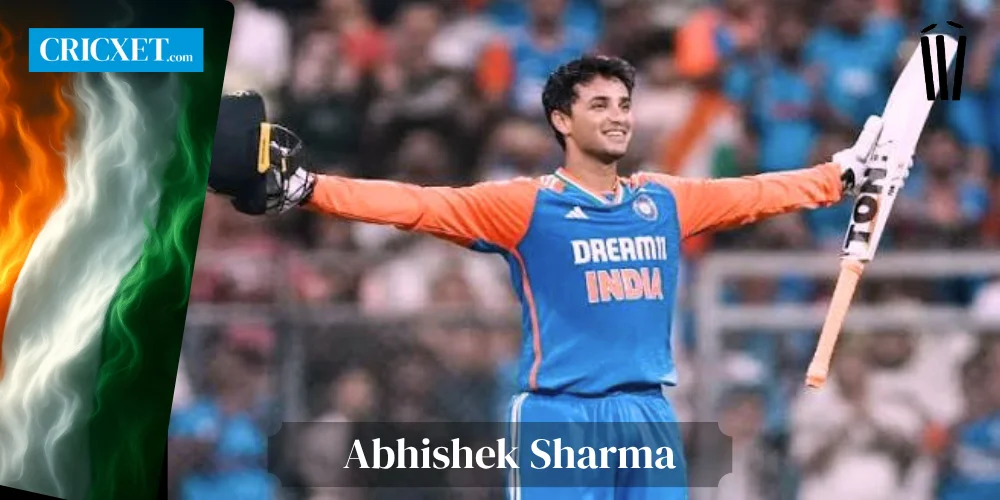
Abhishek Sharma picked up a cricket bat at the age of three and a half. Two decades later, he holds the highest batting rating ever recorded in T20I history. This is the story of how a boy from Amritsar became India’s most explosive opener.
| Full Name | Abhishek Sharma |
| Born | September 4, 2000, Amritsar, Punjab, India |
| Age | 26 Years |
| Height | 5 ft 7 in (1.70 m) |
| Batting Style | Left-handed |
| Bowling Style | Slow left-arm orthodox |
| Role | Batting All-rounder |
| IPL Team | Sunrisers Hyderabad |
| Domestic Team | Punjab |
How Abhishek Started His Career
Abhishek Sharma’s father, Raj Kumar Sharma, played cricket himself and introduced his son to the game at age three and a half. The boy grew obsessed almost immediately. He has two elder sisters and completed his schooling at Delhi Public School.
His numbers as a teenager were already extraordinary. In the 2015-16 Vijay Merchant Trophy, an Under-16 tournament, he scored more than 1,200 runs at an average above 109. He also took 57 wickets that same season. The following year, he captained the side that won the Under-19 Asia Cup title.
The India Call-Up and a Fast Start
Abhishek made his T20I debut against Zimbabwe in Harare on July 6, 2024. His IPL form that same year turned heads too. Batting alongside Travis Head at the top of the order, he played a key role in taking Sunrisers Hyderabad to their first IPL final since 2018.
When Sharma On the Top
The defining moment of his career arrived at the 2025 Asia Cup in the UAE. A half-century against Sri Lanka in the semi-final pushed his ICC T20I batting rating to 931 points. That surpassed a mark of 919 that England’s Dawid Malan had held since 2020, making Abhishek the highest-rated T20I batter in the format’s history. He finished that Asia Cup as Player of the Tournament, with 314 runs at an average of 44.85 and a strike rate of 200.
More records followed within months. During a T20I series in Australia in late 2025 (October-November), he became the fastest player ever to reach 1,000 T20I runs by balls faced, getting there in 528 balls. That beat the previous record of 569 balls, held by Australia’s Tim David. He was named Player of the Series as India won that contest 2-1.
Abhishek Sharma Career Statistics
| Format | Mat | Inns | NO | Runs | HS | Avg | BF | SR | 100s | 50s |
|---|---|---|---|---|---|---|---|---|---|---|
| T20I | 72 | 71 | 2 | 2268 | 135 | 32.87 | 1155 | 196.36 | 4 | 14 |
| IPL | 92 | 89 | 8 | 2379 | 141 | 29.37 | 1389 | 171.27 | 2 | 13 |
Abhishek Playing Style
Abhishek Sharma opens the batting with an attacking mindset from the very first ball. He handles pace and spin equally well, and he draws on lessons from several different players he has studied closely. Yuvraj Singh, Shikhar Dhawan, Brian Lara, and his own SRH teammate Travis Head have all shaped his approach in different ways.
He is also a handy left-arm spinner, capable of surprising set batters with a backspinning leg cutter, which adds a genuine second string to his game beyond his batting.
FAQs
His father, Raj Kumar Sharma, was a former cricketer himself and put a bat in his son’s hands when Abhishek was only three and a half years old.
He began his Sunrisers Hyderabad career in the middle order. The franchise promoted him to open in 2022 after seeing how well his attacking instincts suited the top of the innings, a move that transformed his career trajectory.
His record 931 rating (2025) has not been beaten, but Ishan Kishan briefly displaced him as the No.1 T20I batter in July 2026. Abhishek reclaimed top spot in late October 2026, ahead of Pakistan’s Sahibzada Farhan.
He has cited Yuvraj Singh, another aggressive left-handed batter from Punjab, as one of the players whose game he studied and drew inspiration from while developing his own attacking style.
Yes. He captained India’s Under-19 side to the Asia Cup title in 2016, years before his senior T20I debut in 2024.
He reached the milestone in just 528 balls faced, a mark measured by deliveries rather than innings or matches, which is a different and rarer way of tracking speed to a landmark than the more commonly cited innings-based records.